Hey there! I’m a supplier of Meat Bandsaw Blades. You might be wondering how the blade’s heat-treatment process affects its properties. Well, let me break it down for you. Meat Bandsaw Blade
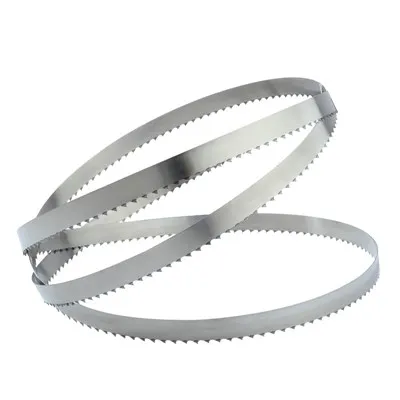
First off, heat treatment is like a magic wand for our meat bandsaw blades. It’s a process that involves heating and cooling the blade in a controlled way to change its physical and sometimes chemical properties. And trust me, these changes can have a huge impact on how well the blade works.
One of the most important properties affected by heat treatment is hardness. Hardness is all about how resistant the blade is to wear and deformation. When we heat-treat a blade, we can increase its hardness. This means the blade can cut through meat more efficiently and for a longer time without getting dull. For example, if we use a higher temperature during the heating phase and then quench the blade quickly, we can form a harder structure in the metal. This is great for meat cutting because meat can be tough, and a hard blade can slice through it like a hot knife through butter. But if the blade is too hard, it can become brittle. And a brittle blade is no good because it can break easily. So, we have to find that sweet spot where the blade is hard enough to cut well but not so hard that it shatters.
Another property that heat treatment messes with is toughness. Toughness is the ability of the blade to absorb energy and resist cracking. When we’re heat-treating our meat bandsaw blades, we want to make them tough. This is because when the blade is cutting through meat, it’s getting hit with all sorts of forces. If the blade isn’t tough enough, it can develop cracks, which will ultimately lead to the blade failing. We can adjust the toughness of the blade by controlling the cooling rate during the heat treatment process. A slower cooling rate usually results in a tougher blade. But again, it’s a balancing act. We don’t want the blade to be too tough and not hard enough, or it won’t cut effectively.
The heat treatment process also affects the blade’s strength. Strength is related to how much stress the blade can handle without breaking. A stronger blade can withstand higher cutting forces. This is super important when we’re cutting through thicker or denser cuts of meat. For instance, when we’re dealing with large roasts or briskets, we need a blade that can handle the pressure. By heat-treating the blade, we can manipulate its crystal structure to increase its strength. We might use a process called tempering, which involves reheating the blade to a lower temperature after quenching. This helps to relieve some of the internal stresses in the blade and improve its strength.
Now, let’s talk about corrosion resistance. You might not think that heat treatment has anything to do with how well a blade resists rust, but it actually does. When we heat-treat a blade, we can change its surface properties. By creating a more uniform and dense structure on the surface, we can make the blade more resistant to corrosion. This is crucial for meat bandsaw blades because they’re often exposed to moisture from the meat and the cleaning process. If a blade rusts, it can not only look bad but also affect its cutting performance. So, we want to make sure our heat-treated blades can keep their cool (literally and figuratively) in a moist environment.
The heat treatment also impacts the blade’s flexibility. A flexible blade can conform to the shape of the meat being cut, which can lead to a more precise cut. When we heat-treat a blade, we can adjust its flexibility by controlling the heat and cooling cycles. If the blade is too rigid, it might not be able to follow the curves of the meat properly, resulting in uneven cuts. On the other hand, if it’s too flexible, it might bend too much and lose its cutting edge. So, we’ve got to nail that flexibility level just right.
As a Meat Bandsaw Blade supplier, I know that getting the heat treatment process just right is crucial. We’ve spent years experimenting with different heat treatment techniques to optimize the properties of our blades. Our goal is to provide our customers with blades that cut well, last long, and can handle the rigors of the meat-cutting industry.
If you’re in the market for high-quality Meat Bandsaw Blades, you should definitely consider working with us. We offer a wide range of blades that are heat-treated to perfection. Whether you’re cutting small steaks or large hams, we’ve got a blade that’s right for you. Our blades are designed to make your meat-cutting jobs easier and more efficient. So, if you’re interested in discussing your specific needs and placing an order, don’t hesitate to reach out to us. We’re here to answer all your questions and help you find the best blades for your business.

In conclusion, the heat treatment process is a game-changer when it comes to the properties of Meat Bandsaw Blades. It can determine how hard, tough, strong, corrosion-resistant, and flexible the blade is. And as a supplier, we take pride in using the best heat treatment techniques to ensure our blades perform at their best. So, give us a shout and let’s start a conversation about how we can meet your meat bandsaw blade needs.
Wood Bandsaw Blade References:
- "Metallurgy for Dummies" by John H. Avery
- "Handbook of Heat Treatment of Steels" by George E. Totten, David Scott MacKenzie, and Jon D. Idol
Zhejiang Sipu Sawing Industry Co., Ltd.
With abundant experience, we are one of the most reliable meat bandsaw blade manufacturers and suppliers in China. Please feel free to buy high quality meat bandsaw blade made in China here from our factory. We also accept customized orders.
Address: No. 1129 Cangling Road, Huzhen Town, Jinyun County, Lishui City, Zhejiang
E-mail: ls@sipu.onaliyun.com
WebSite: https://www.sipu-saw.com/
