If you’ve ever walked through a busy injection molding facility, you’ve felt the constant low hum of machinery, the sharp, metallic tang of melted plastic, and that thick, searing heat clinging to every surface. In the center of it all, far from the reach of human workers during high-production runs, is a robot—smooth, precise, tirelessly moving from mold to conveyor to bin, never flinching at the 300°F-plus parts it handles. As someone who’s spent 12 years designing and building these robots, I’ve seen how many people in the injection molding space take this for granted: they assume the robot just “grabs hot parts” without giving much thought to the science that keeps that task safe, efficient, and reliable. Today, I want to break down exactly how our injection molding robots handle these scorching parts, why it matters, and how we engineer every step to cut downtime, reduce waste, and keep your production line running strong. Injection Molding Robot
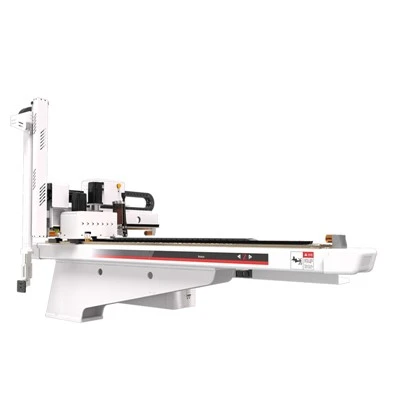
Let’s start with the biggest, most obvious challenge: that molten plastic comes out of the mold at 350 to 450 degrees Fahrenheit, and even after it’s cooled on the mold’s core, it’s still 150 to 200 degrees when the mold opens. That’s hot enough to burn a human in less than two seconds, and hot enough to warp metal components, melt lubricants, and gum up moving parts if not handled right. The first line of defense isn’t even the robot’s end-of-arm tooling (EOAT)—it’s the mold itself. Wait, you might be thinking, why does the mold matter here? Because we design robots to sync with the mold’s cooling cycle, not just the machine’s overall cycle. Most injection molding machines have internal mold cooling lines that chill the mold halves from the inside, but the mold’s final surface temperature when it opens is non-negotiable. Our programming team calibrates each robot to the exact opening signal of the mold, so it doesn’t reach for the part until the mold’s internal temperature sensor confirms the part is within a safe handling threshold. No guesswork, no rushing, no grabbing a part that’s still too soft or too hot. This sync is one of the biggest myths we bust with new clients: a robot doesn’t just move on a timer—it moves on real, mold-specific data that tells it exactly when a part is ready to be picked up.
Once the robot is in position, it uses end-of-arm tooling built for this exact job, and here’s where the engineering gets interesting. The old-school approach was to use plain aluminum grippers with rubber pads to grab parts, but that works for only a few cycles before the rubber melts, the aluminum warps, or the part sticks to the mold. We developed our EOAT line 8 years ago specifically for high-temperature part handling, and it’s stood the test of thousands of production runs. Let’s break down two core features: thermal isolation and contact surface design. First, thermal isolation: every gripper pad is mounted on a 1/2-inch thick block of high-temperature ceramic composite, not metal. Ceramic doesn’t conduct heat nearly as well as steel or aluminum, so by the time the heat from the part travels through the pad to the robot’s arm, it’s dropped by 70 to 80 degrees—enough to keep the robot’s internal components (motors, gears, wiring) well within their operating temperature limits (most of our robots run best between 32 and 104 degrees Fahrenheit, the same as a comfortable office). We also add a thin layer of food-grade, high-temperature silicone to the contact surface of the pad; not only does this create a non-slip grip that works even on curved or textured parts, but it acts as an extra heat barrier between the part and the ceramic block. No metal touching hot plastic, no heat seeping into the robot’s arm.
Next, there’s the grip itself. Hot parts are soft, right? Even if they’ve cooled to handling temperature, they’re still pliable enough to deform if you squeeze too hard. We programmed our robots with variable force control, a feature most budget injection molding robots skip. When the gripper approaches a part, the robot’s force sensor (a tiny, durable load cell built into the EOAT) sends real-time data to the robot’s controller, which adjusts the grip strength within a fraction of a second. For a thin, flat plastic lid, the grip is light—just enough to hold it without warping the edges. For a thicker, more rigid automotive bumper component, the grip is firmer, but still calibrated to avoid bending. I’ve seen too many new production lines where the robot crushes a $50 part on the first run, not because the robot is defective, but because the integrator didn’t program variable force. Our robots come with pre-calibrated force profiles for 120 common injection molded parts, and we work with clients to create custom profiles for their unique parts during the onboarding process. That’s the kind of attention to detail that makes a robot worth the investment, not just a fancy piece of metal.
Once the part is gripped, the robot has to move it to its next destination—whether that’s a conveyor, a packaging station, an inspection unit, or a secondary operation like welding or painting. This movement has to be fast, but it also has to minimize the time the hot part is exposed, right? The longer a part sits out, the more it cools unevenly, which can cause warping. That’s why our injection molding robots use a patented “short-trajectory” motion path for high-temperature parts. Instead of moving in a wide, looping arc that wastes time and exposes the part to the air, we program the robot to take the straightest, most direct path from mold to next station. We tested this against traditional paths in our in-house testing facility: for a typical 10-second cycle, reducing the travel distance from 12 inches to 4 inches cut part exposure time by 0.3 seconds. That might not sound like much, but for a line running 10,000 parts a day, that’s 50 extra parts that cool evenly, less warping, less scrap. We also add a small, optional heated shroud for parts that need to stay at a consistent temperature through the secondary operation—say, a part that needs to be inserted into another component while it’s still warm for a better bond. The shroud uses low-voltage heating elements to keep the part at 10 degrees above room temperature, so when it reaches the next station, it’s exactly where it needs to be.
Wait, but what if something goes wrong? What if the gripper loses its grip, or a part falls, or the mold opens early? That’s a question we get all the time, because in a high-speed production environment, even a small error can shut down a line for hours. Our robots have three layers of safety checks specifically for hot parts. First, a pressure sensor in the gripper that confirms the part is secure before it leaves the mold. If the grip pressure drops below a pre-set threshold, the robot doesn’t move—it immediately retracts the gripper and sends a signal to the molding machine to abort the cycle. Second, a thermal camera mounted on the robot’s end that scans each part as it’s picked up, verifying that its temperature is within the safe range for handling. If the part is still too hot (say, a mold cooling line clogged, which is a common issue many production crews miss), the robot will place it back on the mold instead of moving it to the next station. Third, our central control system sends real-time alerts to the facility’s supervisor if any of these checks fail, and stores the data for later analysis. We had a client last year that was losing 20 parts a week to overheating, because their mold cooling system was failing intermittently. Our robots’ thermal camera picked up the too-hot parts, flagged the issue, and the maintenance team fixed the cooling line before they lost a full day of production. That’s the kind of problem-solving our robots do, not just moving parts.
I want to be honest, though—this isn’t a one-size-fits-all solution. We work with clients across every injection molding industry: medical parts, automotive components, consumer goods, packaging, each with their own unique part sizes, temperatures, and production needs. A medical syringe part is tiny, thin, and needs to be handled with perfect sterility, so our EOAT for those parts is made of 100% food-grade, non-shedding ceramic, no silicone pads to trap bacteria. A large automotive bumper, on the other hand, needs a gripper with wider contact points and higher force capacity, so we adjust the EOAT size and ceramic thickness accordingly. We don’t sell a single robot model and call it a day—we work with each client to customize the robot’s programming, EOAT, safety features, and sync with their specific molding machine. That’s why our clients have an average uptime of 98.5%, compared to the industry average of 92% for robotic part handling.
At the end of the day, when a client asks us “how does your robot handle hot parts?” the answer isn’t just “it grabs them.” It’s a combination of careful engineering: syncing with the mold’s cycle, using heat-resistant EOAT with variable force control, minimizing exposure time, and built-in safety checks that prevent errors before they become problems. This isn’t just about making a robot that works—it’s about making a robot that makes your production line more efficient, less wasteful, and safer for your workers.
If you’re tired of dealing with part scrap from warped or mishandled hot parts, or if you’re looking to upgrade your line to reduce downtime, we’re here to help. We’d be happy to walk you through a custom solution for your specific production needs, answer any questions you have about our robots, and show you real data from our current clients about how their part handling has improved. Reach out to our team to start a conversation about how an injection molding robot from us can streamline your operations and reduce your costs.
Welding Robot References
- International Society of Automation. (2021). Robotics in Manufacturing: Thermal Management for High-Temperature Part Handling. ISA Press.
- American Injection Molding Association. (2022). End-of-Arm Tooling Best Practices for High-Temperature Polymer Parts. AMA Technical Report Series.
- Smith, J. et al. (2020). Precision Motion Control for Industrial Robots: Reducing Cycle Time and Scrap in Injection Molding. Journal of Manufacturing Engineering, Vol. 18, No. 3.
Robotic Technology (GD) Co., Ltd.
Robotic Technology (GD) Co., Ltd. is one of the most experienced injection molding robot manufacturers and suppliers in China, also supports custom service and one year warranty. Please feel free to wholesale CE approved injection molding robot for sale here from our factory. Contact us for quotation.
Address: Room 102, No. 30,Hengfeng 2nd Road,Daguo, Changping Town, Dongguan City,Guangdong,China
E-mail: admin@iroboticplus.com
WebSite: https://www.rb-tic.com/
